Writing12 March 20268 min read
Mathematics is the most beautiful thing in the world. School made sure you'd never find out.
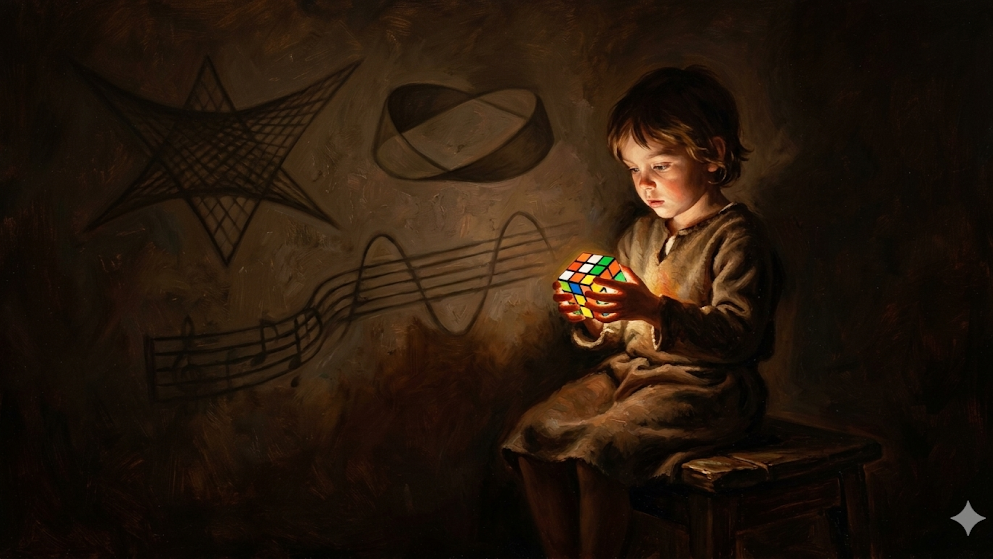
Ask any adult if they love math. Eighty percent will say “no”. Then they’ll add a story—a strict teacher, endless drills with numbers, meaningless formulas, humiliation at the blackboard. And they’ll say “I’m just not a math person” with the intonation of someone who has accepted their sentence and closed the door.
They haven’t accepted anything. Their door was locked from the outside. By the very system that was supposed to open it.
This is not an accident. It’s not a matter of circumstance. It is the direct, predictable result of a fundamental error in how we’ve decided to introduce children to mathematics—an error we’ve been repeating for decades...
Arithmetic is not mathematics. Stop confusing the two.
If you ask most people what mathematics is, they will describe arithmetic. Addition, subtraction, multiplication, division. The multiplication table. Fractions. Maybe a little algebra, where x stands in for the number you don’t know.
That’s about as accurate as saying that literature is spelling.
Mathematics is the study of structure. Of patterns. Of what happens when you change the assumptions. It is a language for describing symmetry, transformation, infinity, probability, space. It is the tool with which Einstein described the curvature of spacetime. The tool with which Shannon measured information.
Arithmetic is bookkeeping. Necessary. Useful. And utterly unsuitable as an entry point into the world of ideas.
We send children on a field trip to the Louvre—and leave them to count the paintings instead of admiring them.
The Rubik's Cube and the death of the multiplication table
Give a child a Rubik's Cube. Don't explain anything. Just give it to them.
They will sit with it for hours. They will try, fail, and try again. No one is grading them. No one is standing over them with a red pen. And yet—they can't stop.
Why?
Because the Rubik's Cube is structurally captivating. It has 43,252,003,274,489,856,000 different positions and only one correct one. And despite this astronomical complexity, every turn is reversible, every mistake is correctable, and the entire object obeys a strict internal logic. The child doesn't know they are working with group theory—one of the most abstract branches of modern mathematics. They just sense that something deep and orderly is hiding beneath the chaos of colours.
This feeling—this is the entry point to mathematics. Not the formula, but the Feeling that behind the apparent disorder lies a structure you can understand, if you just think carefully enough.
The group theory the child is unconsciously engaging with is the same mathematics that describes the symmetries of subatomic particles in physics. The mathematics behind the cube is literally built into the standard model of particle physics. It is everywhere. And a ten-year-old can feel it with their own hands, without knowing its name.
The multiplication table offers none of this. The multiplication table is dead on arrival. It is correct. Impeccably correct. And utterly lifeless.
Anyone who loves music and hates math just doesn't know they love it
When you tune a guitar, you are working with geometric progressions. Each note is the previous one multiplied by exactly 2^(1/12). The well-tempered scale—the system by which every modern instrument is tuned—is a mathematical compromise, invented and perfected by Bach and his contemporaries. They solved a problem that had plagued musicians for centuries: how to tune an instrument so that it sounds good enough in every key, without sounding perfect in any single one. This is an optimization problem. Bach solved it intuitively. Mathematicians formalized it later.
When a child plays a rhythm, they are working with fractions in real time. Quarter notes, eighth notes, sixteenth notes.
And chords. People say that C major sounds happy and D minor sounds sad. But no one explains why. The answer lies in the structure of the intervals—in the ratios between frequencies, in which overtones coincide and which ones clash. C major and A minor share the same six notes, and that's the only reason you can transition between them without your ears protesting. They are two different perspectives on the same mathematical space.
The child learning to play the piano is doing more math than the child in math class. The difference is that one is crying from boredom, while the other wants to stay after class.
Euclid's geometry and why we teach it to children
I'm going to tell you something your math teacher probably never told you. Perhaps because they didn't know it themselves.
Parallel lines meet.
Euclid postulated, 2300 years ago, that through a point outside a line, exactly one parallel line can be drawn. It seems obvious. It seems inescapable. For twenty-three centuries, mathematicians tried to prove this postulate from the others—because it seemed too obvious to be just an axiom. They failed.
And then, in the nineteenth century, Gauss, Lobachevsky, and Riemann asked a question that seemed almost childish: what happens if we assume the postulate is wrong? Not as a mathematical error—but as an alternative choice?
The result was a revolution.
On a spherical surface—the surface of the Earth, for example—all meridians are “parallel” in the sense that they are perpendicular to the equator. And they all meet at the poles. Both poles. Every meridian meets every other meridian in two places. The sum of the angles in a triangle drawn on the surface of the globe is not 180 degrees. It is more—how much more depends on the size of the triangle. A triangle with three right angles exists quite happily on a sphere. On a plane, it is impossible.
On a hyperbolic surface—imagine an infinite saddle-shaped surface—the sum of the angles is less than 180 degrees. And through a point outside a line pass not one, but infinitely many parallels.
Einstein used precisely Riemannian geometry—the geometry of curved surfaces—to describe the General Theory of Relativity. Gravity is not a force in his theory. It is the curvature of spacetime. Mass warps the geometry of the Universe. And geometry tells matter how to move.
Every airplane flying from Sofia to New York flies along an arc. Not a straight line on the map. It follows the shortest path on a spherical surface—a geodesic line. Pilots and navigators work in spherical geometry every day.
And we teach Euclid as the only reality. As absolute truth. We don't tell children that it is only correct in a limited, local approximation of a flat surface.
Martin Gardner and how a mathematician is born
When I was twelve, I came across the books of Martin Gardner.
Not textbooks. Not problem sets. Puzzles, paradoxes, mathematical games, coded messages that I exchanged with friends and no one around us could decipher. Conway's Game of Life—a cellular automaton with three rules from which infinite complexity is born. Self-replicating structures. Patterns that crawl across space. Chaos from three sentences.
The Möbius strip. You take a strip of paper, twist one end 180 degrees, and tape the two ends together. You get a surface with only one side. Start drawing a line down the middle—you will traverse the entire surface and return to the beginning without lifting your pencil. If you cut the strip along this line, you don't get two strips. You get one—longer and more twisted. Cut it again—and you will be surprised once more.
Any seven-year-old can do this with paper, scissors, and tape. And they will pose questions that mathematicians have worked on for decades.
Gardner never made me “solve something”. He never made me memorize a formula. He made me wonder. And wonder precedes formalism. Not just pedagogically—ontologically. You don't need definitions to feel that something is true. You don't need a proof to feel that something requires an explanation.
No textbook made me a mathematician. Gardner did. Without making any effort to do so. Just by showing things as they are—incredible.
The alternative is right in front of us.
Here is what we can do instead of the multiplication table.
Game theory—with real games. The Prisoner's Dilemma with two friends and real stakes. Two children, two rooms, one decision, no communication. If both stay silent, both win a little. If one betrays the other, the betrayer wins big, and the other loses everything. If both betray, both lose.
The child will discover the Nash equilibrium. They will discover the iterated dilemma and the “tit for tat” strategy—cooperate on the first move, then copy your partner's move. They will discover that cooperation is mathematically optimal given a long enough horizon of interaction. Biologists use this math to explain evolution. Economists, to model markets. Political scientists, to analyze international relations.
All from one game. Without a textbook.
Origami. Geometry with your hands. But not Euclidean geometry—a more general one. With origami, you can trisect an angle. Divide any angle into three equal parts. This is mathematically impossible with a straightedge and compass—Galois proved it in the nineteenth century, before being killed in a duel at the age of twenty. But it is perfectly achievable with paper folding. Origami is more powerful than a straightedge and compass. The Huzita-Hatori axioms define operations unattainable for Euclid.
Poker and probability theory. Not the gambling—the mathematics. Expected value. Bayesian updating—how you should change your beliefs when presented with new information. The child who understands when to bluff and when to fold understands something deep about uncertainty and rational decision-making under incomplete information. This is philosophy. This is statistics. This is life.
Ask “If seven friends shake hands with everyone else—how many handshakes are there?” instead of “What is 7 times 8?” The math is identical. But one question kills curiosity, and the other gives birth to it. One has an answer. The other has an idea.
Final thoughts
If your child hates math—it's not the child's problem. The child was not born with an aversion to structure and patterns. No child is. They acquire it. Methodically. Year after year. Lesson after lesson.
It's not math's problem. Mathematics is the most beautiful thing in the world. It is everywhere—in music, in card games, in the Rubik's Cube, in the flight path of an airplane, in the way diseases spread, in the way snowflakes form, in the way the Universe has decided to organize matter.
The problem is who first showed them mathematics—and what exactly they showed.