Writing13 April 20264 min read
The AI Apocalypse Won't Come From Superintelligence — It Will Come From Layoffs
We spend an awful lot of time worrying about the wrong catastrophe.
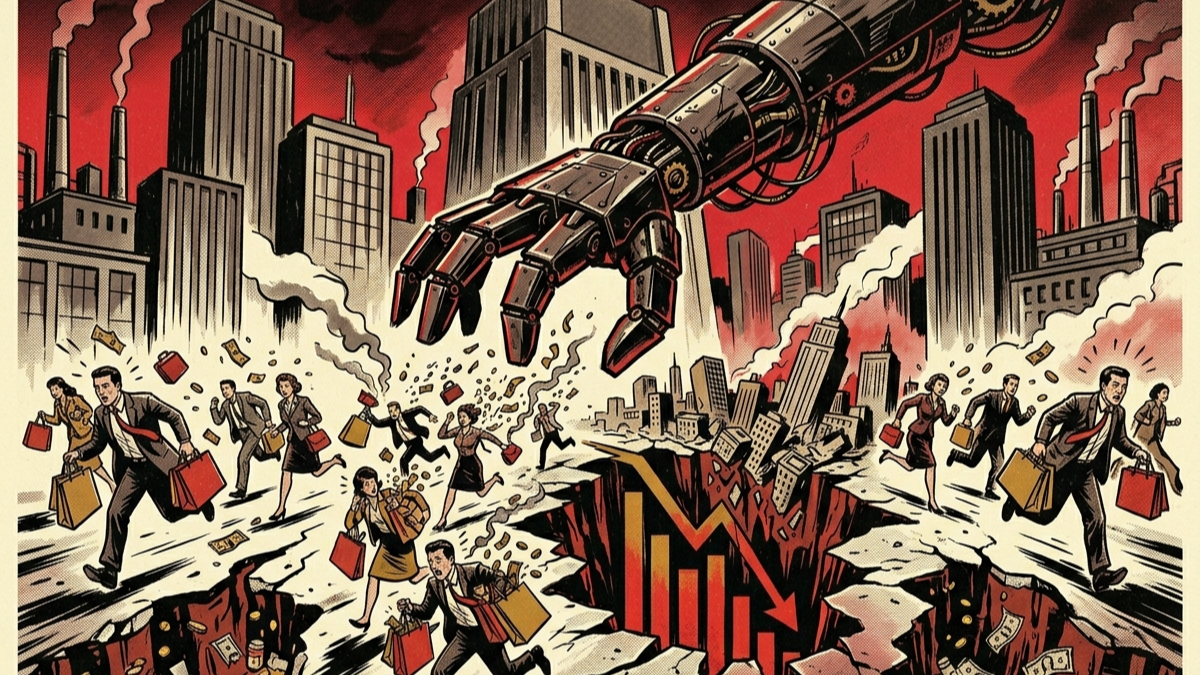
We spend an awful lot of time worrying about the wrong catastrophe.
The existential risk crowd is fixated on some future rogue superintelligence that decides humanity is redundant. Fine. Maybe that's a real problem someday. But there's a far more mundane apocalypse unfolding right now, in quarterly earnings calls and restructuring memos, and it has nothing to do with machines becoming too smart. It has everything to do with us being too predictable.
Here's what's happening. Block fires nearly half its workforce. Salesforce replaces 4,000 customer support agents with AI. Goldman Sachs deploys coding agents that let one senior engineer do the work of five. Over 100,000 tech workers laid off in 2025 alone, with AI cited as the primary driver in more than half those cases. And every CEO watching this thinks the same thing: if I don't do it, my competitor will, and then I'm dead.
That reasoning is locally rational. And collectively suicidal.
A recent paper by Hemenway Falk and Tsoukalas from UPenn and Boston University — "The AI Layoff Trap" — formalizes this with uncomfortable precision. They build a task-based model where N symmetric firms each choose an automation rate α. Every automated task saves the firm s = w − c in labor costs. Good. But every displaced worker is also a consumer, and the demand lost per displaced worker is ℓ = λ(1−η)w, where λ is the marginal propensity to consume and η is the fraction of lost income recovered through reemployment.
Here's where it gets ugly. When firm i automates, it captures the full cost saving s, but it bears only ℓ/N of the demand destruction. The rest falls on its competitors. So each firm's profit-maximizing automation rate overshoots the collectively optimal one by a wedge of ℓ(1−1/N)/k, where k is the integration friction. More competition — larger N — makes the problem worse, not better. A monopolist would internalize the whole thing. A fragmented market races to the bottom.
Think about that. The very thing we celebrate — competitive markets — is the mechanism driving the destruction.
In the frictionless limit, where k approaches zero — meaning AI becomes trivially easy to integrate — the game collapses into a pure Prisoner's Dilemma. Every firm fires everyone. Not because they're evil. Not because they're stupid. Because firing everyone is a strictly dominant strategy. Even if every CEO in the room understands that collective restraint would raise all their profits, no individual CEO can afford to be the one who holds back. The deviator gets crushed.
And the loss isn't a transfer from workers to capital. That's what people get wrong. It's deadweight loss. Both sides lose. The paper proves this formally: the Nash equilibrium is Pareto dominated by the cooperative optimum. Workers lose income. Owners lose revenue. Nobody wins. Everyone automates. Demand collapses.
Now — what about the usual policy proposals?
Universal Basic Income? Doesn't touch the externality. It raises the floor on living standards but changes nothing about the per-task automation incentive. Mathematically, UBI enters only through the constant Π₀, which drops out of the first-order condition entirely.
Capital income tax? Same problem. Multiplying profits by (1−t) doesn't change the optimization. The tax cancels from the first-order condition. You're taxing the wrong thing.
Worker equity participation? Gets closer. Profit-sharing recycles some capital income back into demand, shrinking the effective N that each firm faces. But it can't close the gap unless λε = 1, which requires sharing more than 100% of profits when λ < 1. And it won't arise voluntarily — zero profit-sharing is itself a dominant strategy.
Retraining and upskilling? Helps by raising η, which shrinks ℓ. But it's slow, and it can't eliminate the wedge on its own.
Coasian bargaining? Fails completely. The externality is multilateral and diffuse. Automation decisions aren't contractible across firms. And because automation is a dominant strategy, no voluntary agreement is self-enforcing. You can't handshake your way out of a Prisoner's Dilemma.
The only instrument that actually works, according to the model, is a Pigouvian automation tax — a per-task levy set at τ* = ℓ(1−1/N), which is exactly the uninternalized demand loss each firm imposes on the rest of the market. It forces every firm to face the true social cost of its automation decision. And if you funnel the revenue into retraining programs that raise η, the tax shrinks its own necessity over time. It's potentially self-limiting.
There's a deeper lesson here, and it's one that should disturb anyone who thinks markets self-correct by default. They often do. But not always. And not here. The competitive pressure that normally disciplines firms into serving consumers is the same pressure that's driving them to eliminate those consumers. The invisible hand, left to its own devices, is reaching for its own throat.
We don't have a superintelligence problem. We have an incentive problem. And incentive problems don't solve themselves just because everyone in the room is smart enough to see the cliff.
The cliff doesn't care how smart you are. It only cares whether you stop.