Writing24 May 20253 min read
The Tyranny of Bureaucracy and the Heroic Individual
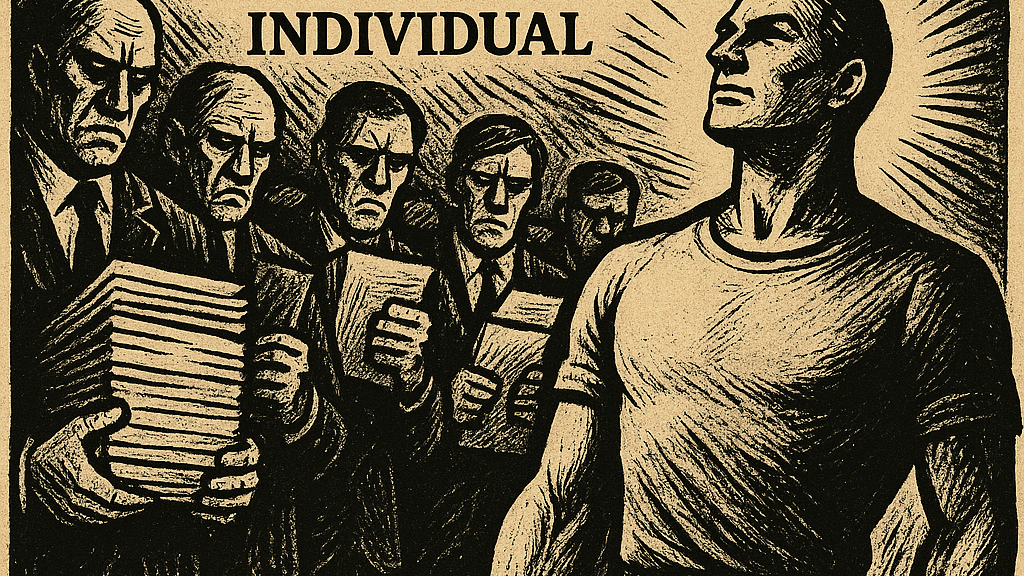
Look, it's not bloody complicated. When you have a society that prioritizes—and I mean really prioritizes—the creation of tangible value through disciplined work and innovation, you see something remarkable happen. You see human beings standing up straight with their shoulders back, confronting the chaos of existence, and transforming it into order. That's what production is, fundamentally. It's the heroic individual wrestling with the unknown and bringing forth something of value.
But what happens—and this is absolutely catastrophic—when we allow bureaucratic structures to metastasize like a malignant cancer throughout our social institutions? We create a hell of our own making. I'm not being hyperbolic here. The evidence is bloody well overwhelming.
Order vs. Chaos: The Productive Society and the Bureaucratic Nightmare
In an industry-driven society, the archetypal hero—the competent, truth-speaking individual—can flourish. The state functions as it should: maintaining the boundaries within which the game can be played fairly, not dictating every bloody move. This isn't just some abstraction. It's precisely what allows human beings to ascend hierarchies of competence rather than tyranny.
Contrast this with the pathological alternative: a system so tangled in its own regulatory web that it strangles the life out of those trapped within it. This isn't mere inefficiency—it's a form of ideological possession that attacks the very sovereign individual upon which Western civilization was built.
Consider the manifestation of these opposing forces:
When a factory seeks expansion in a society oriented toward order and production, it must demonstrate its competence—its ability to bear responsibility. That's it. That's the price of admission. And it's right that this should be the case.
But in the bureaucratic hellscape? My God. You're navigating an endless labyrinth of permits, approvals, and arbitrary judgments from administrators who are themselves often operating within hierarchies of power rather than competence. And that's not just inefficient—it's morally wrong.
The Economics of Meaning vs. The Pathology of Waste
Here's something to really think about: When a state properly orients itself toward meaning—and meaning is inextricably linked with productive value—it allocates resources toward the infrastructure that enables human flourishing. Roads, bridges, research institutions—these aren't just expenditures. They're manifestations of our collective commitment to truth and progress.
But a bureaucracy consumed by its own internal logic? It's like the mythological serpent devouring its own tail. It diverts precious resources toward maintaining structures that produce nothing but their own perpetuation. And that's not just economically unsound—it's existentially dangerous.
The warning signs are always there. Always. The bloated administrative state is not merely inefficient—it's the precursor to tyranny.
The Integration of Labor and Capital vs. The Forced Dichotomy
Now, this is crucial: In a properly functioning economy—one based on truth and competence—there isn't this pathological division between labor and capital. That's neo-Marxist thinking, and it's dangerously wrong. Instead, there's an integrated relationship where productivity leads to prosperity for all participants.
The workers in a highly productive enterprise aren't oppressed by their employers—quite the opposite. They're engaged in a meaningful collaboration that elevates everyone involved. That's how hierarchies of competence function.
But when the state—intoxicated by ideological possession—imposes artificial divisions, it creates unnecessary suffering. And make no mistake, this isn't compassion. It's resentment masquerading as virtue.
The Decision-Making Hierarchy: Competence vs. Tyranny
A society that values truth makes decisions based on competence. Period. There's no other stable way to organize human social structures. We've known this since the dawn of civilization.
When infrastructure projects proceed efficiently, it's because they're guided by those who have demonstrated their ability to bear responsibility—to transform chaos into order. That's the proper hierarchy.
But a system paralyzed by administrative overhead? It's the manifestation of ideological possession. Projects that could enhance human flourishing are strangled in their crib by those who have confused power with competence.
The Heroic Alternative
The great industrial pioneers—Ford, Carnegie—they weren't just businessmen. They were manifestations of the archetypal hero, confronting chaos and transforming it into order. Even Theodore Roosevelt, properly understood, wasn't advocating for bureaucratic overreach. He was calling for the proper balance—the integration of responsibility and opportunity that allows for genuine progress.
Their shared vision wasn't simply economic—it was profoundly moral. The state should maintain the boundaries of the game, not dictate its every move. And societies that understand this fundamental truth don't just experience material prosperity—they create the conditions under which human beings can pursue meaning.
And that, my friends, is no small thing.